

When the Patient Says “Enough”: Holding Space for Surrender Without Shame
There comes a moment in some metastatic breast cancer (mBC) experiences when the word “enough” becomes an act of love. For some, that moment may come after years of treatment and resilience; for others, it may never come at all.
This reflection is written for patients and the caregivers who walk beside them — those who may one day face a crossroads where they question whether continuing treatment is still aligned with their body, their values, or their quality of life, and who are seeking compassion, empathy, and clarity as they consider what comfort care could look like.
When that transition happens — when the decision is made to transition toward comfort care — life often feels different. The calendar that was once filled with appointments, scans, and treatment cycles may start to shift. The focus turns from what’s next medically to what matters most personally. And in that shift, there is often a quiet, unexpected space — a space to breathe, to soften, and to reflect in a way that daily medical routines often don’t make room for.
It becomes a time to ask deeper questions:
Whom do I still want to say I love you to?
Is there someone I want to say I’m sorry to?
Is there someone I need to say I forgive you to?
Surrender is not defeat. It’s the moment we gently release control and return to what is most human — love, connection, and grace. It’s a choice to honor the body’s limits. It’s the courage to say, “I have done enough.”
There is a quiet relief that comes with this kind of surrender — a deep exhale after months or years of holding everything together. It is bittersweet, yes. The heartache of what’s being let go of sits right beside the peace of acceptance. These tender moments — where grief and gratitude coexist — remind us that surrender can be a form of healing, too.
A Caregiver’s Perspective on Agency and Dignity
Walking alongside a loved one with metastatic breast cancer brings a kind of strength you don’t know you have until you’re called to use it. Nothing prepared me for the day I sat in the care-planning meetings at the hospital, surrounded by my sister’s care team, after she experienced a medical emergency.
When those meetings began, I came prepared. I had questions, did the research, and carried the determination to understand every option placed before us. I wanted to be an active participant in her care planning — to make sure we considered what was truly best for her, not just what was medically possible.
As the physicians spoke, I sensed their compassion, but also their unease. These were not easy conversations. They explained every path — each offering the possibility of a few more months but at a cost that would take nearly everything she had left. My questions led to the scenarios — the best, the likely, the worst — and though each answer was painful, I appreciated their honesty and thoroughness.
By then, I had become an expert at compartmentalizing my emotions. Looking back, I often share that I had to operate like a machine just to get through conversations of that weight. One member of the care team even asked if I worked in healthcare — a reminder of how composed and clinical I must have sounded while carrying so much emotion beneath the surface. It was the only way I knew to stay focused on what my sister needed.
Being included in those conversations allowed me to honor her and her wishes. Transitioning toward comfort care was not about giving up — it was about listening deeply to what her body needed and helping her live her final days with dignity by choosing peace over more pain, quality over quantity.
For the Physicians Who Carry the Weight
I once had a conversation with an oncology nurse who told me, “The doctor lights up when he sees his long-standing patients. They give him hope.” I had never truly considered how deeply physicians feel the weight of outcomes they cannot change. She shared that it hurts — every single time the doctor cannot save a life. In that moment, I realized oncology is not just medicine; it is emotional labor, spiritual labor, human labor.
Families often see doctors as unshakable. But they carry storms of their own — the lives they fought for, the ones they lost, the impossible conversations they must guide with honesty and compassion. And yet, even in the most difficult moments, they offer something essential: truth, clarity, and permission to find peace.
For every doctor who struggles to have these conversations, please know — you are not failing. You are helping your patients and their families reclaim the time, space, and dignity they deserve. You are giving them the ability to decide how they wish to live the rest of their days — in comfort, surrounded by love, and grounded in honesty.
When you speak the truth with kindness, you don’t take away hope — you simply help it evolve. You give it new meaning. And that, too, is healing.
Hospice as a Space for Peace
When my sister entered hospice, time softened. Days became quieter. I had the honor of sharing conversations about eternal hope — the kind that holds steady even as the body grows tired. We reminisced, looked through old photos, and laughed at memories that felt like home. I helped her bathe and styled her hair afterward — a small gesture that felt deeply meaningful. She spent time with her children, and with the support of a social worker, we helped them prepare for what was coming.
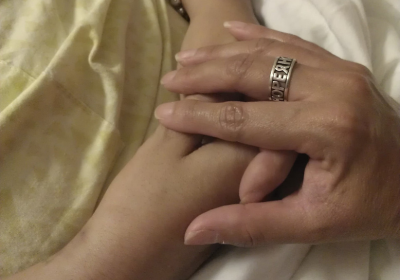
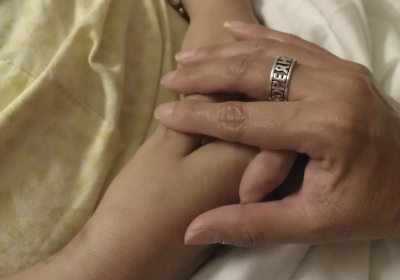
My father got to hold his little girl’s hand, talk to her gently, and simply be her dad again — moments that would never have happened in a busy hospital room. Our family sat with her, played her favorite music, fed her, and offered our goodbyes in ways that felt natural and loving.
I was able to ask her about her wishes for the “after.” We cried. We laughed. And when she couldn’t keep her eyes open any longer, she knew I was there, holding her hand, telling her it was okay to rest — that she didn’t have to fight anymore. She met that moment with incredible courage.
Hospice didn’t take anything away from her. It gave her what she deserved: comfort, connection, presence, and peace.
Surrender, in this setting, is not about loss — it’s about choosing comfort and dignity. Whether that happens at home or in a hospice facility, it’s about giving the body permission to rest and the heart permission to be free.
Hope, Dignity, and Listening to the Body
In the end, surrender isn’t about losing the fight. It’s about choosing how we live, love, and let go — whenever that time feels right. It’s about honoring the body’s wisdom — listening when it tells us it’s tired, when it’s done fighting, when it simply needs rest. The body often knows before the mind is ready to accept it. Listening to it, rather than overriding it, is one of the most compassionate choices we can make. Hope doesn’t disappear in comfort care; it simply transforms.
Hope becomes the desire for meaningful moments.
Hope becomes relief from suffering.
Hope becomes the courage to say I love you one more time.
For caregivers, surrender can also bring a complicated kind of relief. Many patients fear letting their families down when they can no longer fight. But when loved ones say, “It’s okay to rest now” – something profound happens. The weight shifts for everyone. The fear softens and the body eases, which offers peace in the shared release of control.
Helping someone reach that moment is an act of profound humanity. It’s in those exchanges — a touch, a whisper, a nod and shared silence — that we see what love truly means.
And for those who may one day face this decision, may you remember: Surrender does not mean defeat.
It is an act of love,
an act of courage,
and an act of peace.
When we surrender and hold one another close, we discover that even in the ending, there is a kind of beginning — a gentle reminder that love, in all its forms, always remains.
This blog post was created in paid partnership with Pfizer.